






















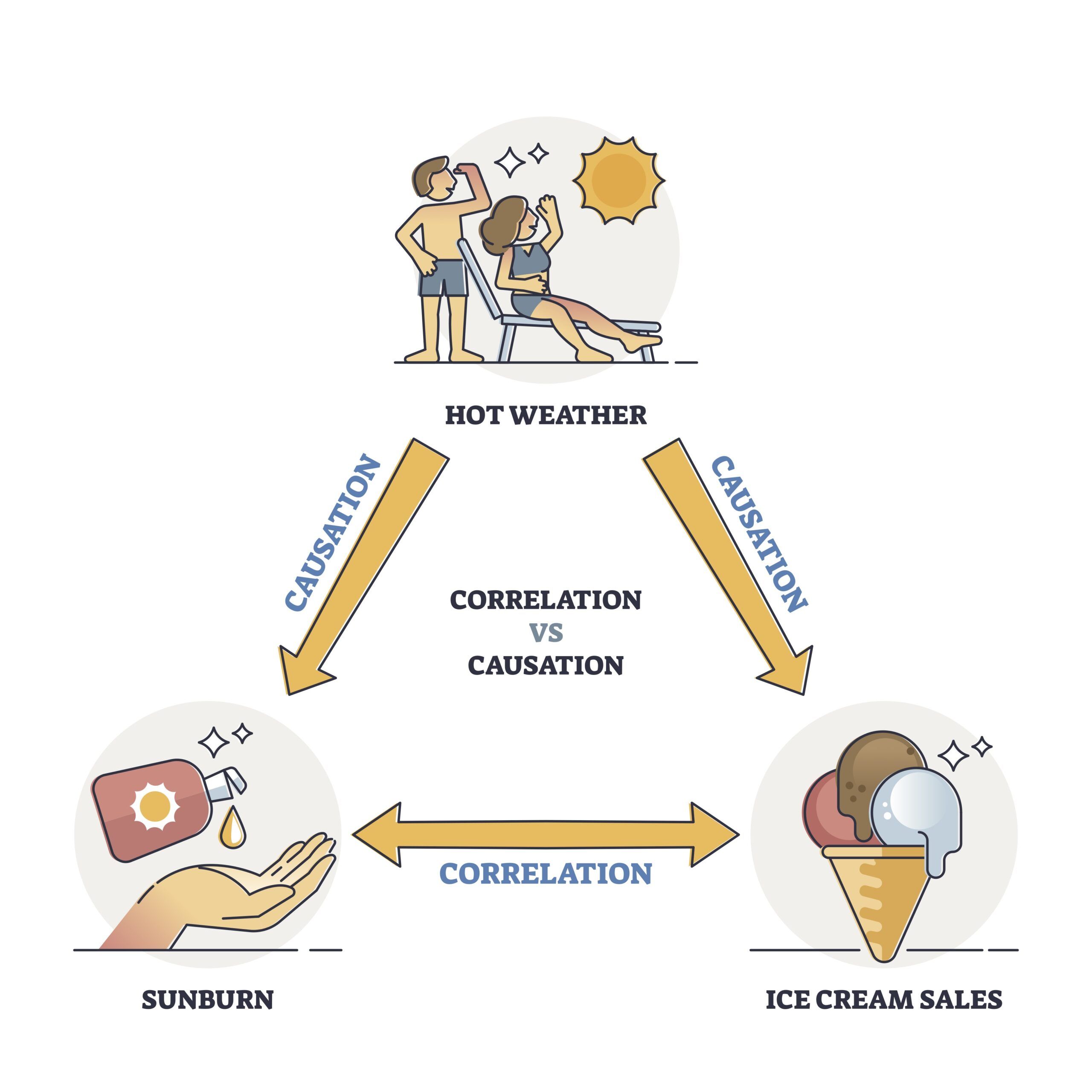
Did you know eating ice cream increases your risk for sunburn? That’s not actually true, of course. But if you make a graph comparing ice cream intake and cases of sunburn over time, you’d see they’re very similar. This is a correlation (also called an association)—where two or more factors change in a similar direction, but don’t necessarily influence each other. In causation (cause-and-effect), a change in one factor is caused by a change in the other.
Much health misinformation is based on a misunderstanding of the distinction between correlation and causation. Knowing how to tell the difference can help you make more informed decisions about your health.
What Does That Prove? As the example of ice cream sales and sunburns shows, correlation is not causation. The frequency of these factors may rise and fall together, but that doesn’t prove one of them causes the other. (In this case, another factor—the weather—is responsible for the association.)
This kind of correlation crops up all the time in all kinds of research. These observations are used to develop hypotheses that can be tested for cause and effect. But acting on an observed correlation without further investigation can be unwise. For example, an observational study showed that use of vitamin E supplements was associated with lower risk for cardiovascular disease (CVD). Based on this evidence, people started taking vitamin E supplements. It turned out that the people in the study who chose to take vitamin E supplements had healthier lifestyles overall, and this was likely responsible for their lower CVD risk. (Note that high doses of vitamin E supplements—over 1000 milligrams a day—are associated with higher risk of bleeding, stroke, and possibly prostate cancer.)
In the vitamin E example, healthy lifestyle is a confounding factor—a variable that influences both the presumed cause and the presumed effect in a study, creating a correlation between them, but not establishing causation. Another example of a confounding factor comes up in some arguments for consuming coconut oil. Studies show the Polynesian inhabitants of Tokelau island, who historically consumed a diet rich in coconut products, have relatively low rates of CVD. But this does not mean eating coconut products lowers risk for CVD. The lifestyle of the Tokelau islanders is extremely different from our own. Their overall dietary patterns are much healthier than Western diets, they are very physically active, and they have lower rates of overweight and obesity. All of these factors strongly influence cardiovascular health. Genetics could also be at play in this example. In other words, there are too many confounding factors to determine what impact the intake of coconut products has on their health—let alone whether it would have similar effects on the health of genetically-different people who live a very different lifestyle.
Prove It. It’s very difficult to prove causation when you’re dealing with an organism as complex as a free-living human being. To prove cause-and effect, we ideally want conduct a study where every variable is controlled but the one we’re studying. But it’s impossible and impractical (and unethical) to control every aspect of a large group of people’s environment and choices. Even if that were possible, natural genetic variations mean not all people will respond the same way to the same intervention.
Some studies, therefore, use animals or work with cells or tissues in a lab to try to establish cause-and-effect. We have to be careful applying the results of these studies to humans, because individual cells and even animals do not have systems identical to humans. For example, the artificial sweetener saccharine was found to cause higher risk of bladder cancer in rats, but it turns out the mechanism by which saccharine causes tumors in rats does not occur in humans.
It is common for studies to observe large numbers of people for long periods of time in an attempt to find meaningful correlations. Because there are so many variables at play, researchers studying the same thing may come up with different results. Statisticians and other scientists can pool the results of these observational studies (in a systematic review) and, if there is adequate data, combine the findings (which is called a meta-analysis).
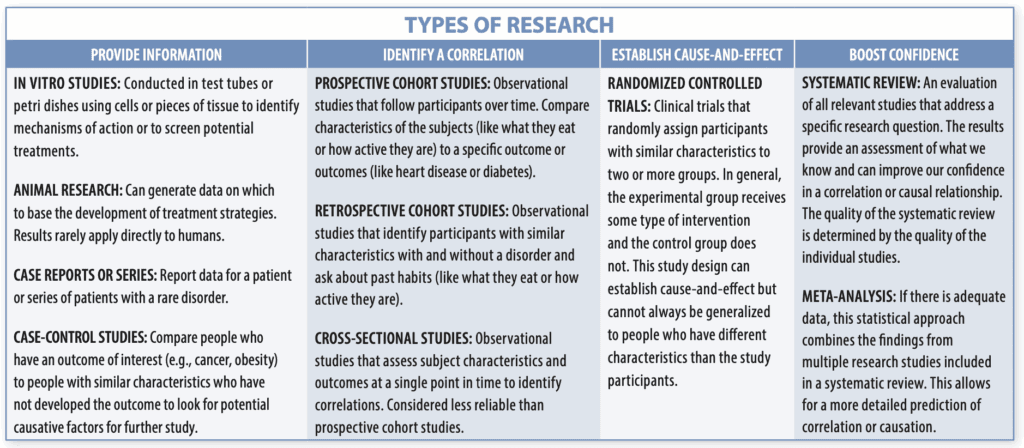
Even consistent results from meta-analyses of observational studies cannot prove cause-and-effect. The gold standard for establishing causation is randomized controlled clinical trials. Volunteer participants are randomly assigned to be in one of two (or more) groups, usually an experimental group and a control group. By establishing inclusion/exclusion criteria for study entry and randomly assigning participants to a group, characteristics of these groups (such as age, gender, ethnicity, and body composition or other relevant factors like education or physical activity level) will be similar. The experimental group gets the intervention (a new drug, a supplement, a specific dietary pattern, a physical activity routine, or whatever else is being studied), and the control group gets a placebo, a different treatment, or nothing at all. If a change in certain predetermined measures is seen in the experimental group but not in the control group, it is likely the result of the intervention. If not, it is concluded that the intervention was not effective. This study design and others are described in detail in the “Types of Research” table.
➧ Be Skeptical. Hidden factors, poor design, and even bias can contribute to study results. Established findings will be incorporated into official recommendations and/or stated on “.org” websites. People trying to sell you something are more likely to cherry-pick studies or misrepresent or exaggerate results for their own gain.
➧ Look at Study Design. Keep in mind that only well-designed randomized controlled trials can truly prove cause-and-effect.
➧ Watch the Language. When we say one factor is “associated with”, “correlated with” or “related to” another, it means causation has yet to be established.
What to Do. Look at health claims—even those that cite research studies—with a skeptical eye. Could there be confounding factors? Do you know if the studies behind the claims were randomized controlled trials, or might they have been observational studies that can only establish a correlation? Also keep in mind that studies that are small, poorly designed, or biased do not provide strong results. (Also, consider if the person or business making the claim is trying to sell you something!)
The best way to confirm a claim is to find it discussed by an unbiased, reputable source—like websites ending in “.org”. For example, if a supplement or diet plan claims to be good for cardiovascular health, see what the American Heart Association (heart.org) says about it. If a website claims people with type 2 diabetes should “never eat” a particular food, type that food into the search bar at diabetes.org (the American Diabetes Association). It is the mission of non-profit organizations like these to analyze all available research so you don’t have to.