


















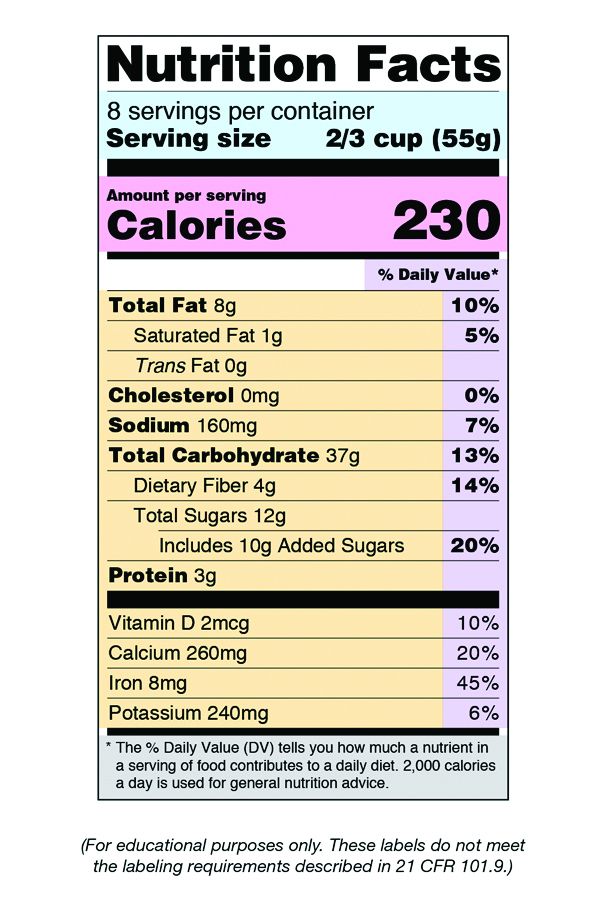
Flip over any food or drink package and you’ll see a Nutrition Facts label. This helpful little chart is required to provide data on the per-serving content of calories and nutrients that are important to health (see image). “By revealing the content of key nutrients, the nutrition facts label can help you select healthier choices and balance your diet,” says Jeffrey B. Blumberg, PhD, research professor at the Friedman School of Nutrition Science and Policy. Here’s how:
Step 1: Know your personal needs. “The label can help you focus on what’s most important to you,” says Blumberg, “including managing a specific health condition.” If you have diabetes, for example, you’ll want to pay particular attention to Total Carbohydrates. If you have (or wish to avoid) high blood pressure, sodium content will be particularly important.
Step 2: Check the serving size. The nutrient amounts listed are for one serving of the size listed in the top section of the chart. “It’s important to recognize that the listed serving size reflects how much people typically eat at one time,” says Blumberg. “It is not a recommendation for how much you should eat.” Remember, if you eat twice the serving size, you’re getting twice the amount of each nutrient—good and bad.
Step 3: Look at the calories. See how many calories a serving has, but don’t choose foods solely based on caloric content. Some low-calorie foods have little nutritional value and/or may be high in sodium, added sugars, or refined starches, while some higher calorie choices may be rich in health-promoting components like mono- or polyunsaturated fatty acids, dietary fiber, or calcium.
Step 4: Look at the “% Daily Value” column. The Percent Daily Values (%DV) provided in the column on the right are designed to help you see how a product fits into your overall dietary pattern. Your goal should be to reach 100 percent of fiber, vitamins, and minerals in a day (from all foods, not just packaged foods with Nutrition Facts labels). You also want to stay below 100 percent of saturated fat, sodium, and added sugars in a day. A serving that contains over 20%DV of a nutrient is considered high in that nutrient. Under five percent is considered low.
➧ Note Serving Sizes. If you eat more or less than the listed amount, you will be getting more or less of each nutrient and calories.
➧ Check the Value. Use Percent Daily Value (%DV) to see how a food fits into your overall dietary intake.
➧ Compare. Look at nutrition facts labels on similar products (like crackers, breakfast cereals, and yogurts) to find the best option for you.
Step 5: Compare. “The Nutrition Facts label can also help you compare similar food products you are considering purchasing,” says Blumberg. You might compare the amount of sodium in different brands of crackers or added sugars in yogurts and choose the one that best meets your goals.